Undergraduate programmes after Class 12
Explore bachelor’s degrees across academic fields in India and abroad. See what you study, how long it takes, campus or online options, and what the degree can lead to.
Explore undergraduate programmesHigher education and career guidance for students and parents. Make informed decisions about programmes, degrees, universities and career pathways in India and abroad — including campus, online and distance-learning options.
Start with the level that matches your next decision — after Class 12, after a first degree, or while you work.
Explore bachelor’s degrees across academic fields in India and abroad. See what you study, how long it takes, campus or online options, and what the degree can lead to.
Explore undergraduate programmesCompare master’s, postgraduate diplomas and advanced courses by field and career goal. Includes campus and online options for graduates and working professionals.
Explore postgraduate programmesFlexible online and distance-learning degrees for students and working professionals. Check recognition, schedule and whether the credential fits your next step before you apply.
Explore online educationOpen a field to see programmes, degree types, career paths and India-versus-abroad options.
Students rarely start with the words “higher education”. They start with a subject. Use the list below to move from a field to undergraduate, postgraduate and online courses.
Foundation routes, broad first degrees and general qualifications after school.
Explore this fieldTeaching, training, pedagogy and education-leadership pathways.
Explore this fieldLanguage, culture, history, philosophy and creative study.
Explore this fieldSociety, behaviour, media, research and communication programmes.
Explore this fieldManagement, commerce, finance, operations, entrepreneurship and law.
Explore this fieldScientific inquiry, analysis, laboratory work and quantitative study.
Explore this fieldComputing, software, data, networks and digital systems.
Explore this fieldDesign, systems, production, infrastructure and applied technology.
Explore this fieldFood systems, land use, sustainability and animal-focused study.
Explore this fieldHealth sciences, care, wellbeing and public-health pathways.
Explore this fieldHospitality, tourism, security, transport and service-sector careers.
Explore this fieldA clear path from “what should I study?” to a decision you can explain at home.
Guidance starts with the student, not with a course catalogue. We then compare level, field and study mode — study in India or study abroad, campus or online.
Interests, strengths and career goals — not only course names.
Fields, programmes, degrees and universities, organised by undergraduate, postgraduate and online study.
Study in India, study abroad, campus and online — using the same questions for each option: eligibility, duration, cost and recognition.
Speak with an advisor when you want a second view. Counselling is a next step, not a requirement to use this site. WhatsApp +91 96506 00628
University admissions and online education experience.
Online Study Asia is led by practical work across university admissions and online and distance education in India. The aim is straightforward: help families understand programmes, universities and study modes before they act.
Experience that understands how applications and study modes actually work.
Admissions Experience
Years working across university admissions.
Online Education
Years of experience in online and distance education in India.
Coverage
Guidance on Indian and international education pathways.
Approach
Designed to help students understand choices before they apply.
If you know the kind of work you want, begin here. We connect that goal to fields and programmes.
Some students start with a subject. Others start with a job they can picture. Both routes lead to the same comparison of courses in India and abroad.
A balanced comparison — not a push in one direction.
See undergraduate, postgraduate and online courses in India: universities by field, study mode, affordability and local career context. This route often suits families who want familiarity, a clearer cost picture or to stay close to home.
Compare destinations, entry requirements, progression routes and plans after the degree. Written so you can weigh global exposure against cost and long-term goals — not so you are sold a single country.
Bachelor’s degrees in India and abroad — campus and online.
An undergraduate programme is the first long academic choice after school. It should fit what the student enjoys, what the family can support, and what doors the degree should leave open — work, a professional exam, or a master’s later.
Start with interests and strengths, not with the most familiar course title. Then check eligibility, duration, fees, recognition and study mode.
For graduates and working professionals comparing the next qualification.
A postgraduate programme should do a specific job: deepen a field, support a career change, or meet a professional requirement. Master’s degrees, PG diplomas and advanced certificates are not interchangeable. Compare field, duration, mode and recognition before you apply.
Flexible study for students and working professionals — with recognition checked first.
Online education in India is a real option when the university is allowed to offer that programme in online or distance mode. For Indian online degrees, confirm the institution on the UGC Distance Education Bureau lists, and read what employers or further-study routes will accept. A low fee is not enough if recognition is unclear.
Management, commerce, finance, operations, entrepreneurship and law — undergraduate, postgraduate and online.
This field covers how organisations work, how money and rules sit around them, and how people start or run a venture. It suits students who like structured problem-solving, numbers, argument or enterprise.
Bachelor’s degrees such as BBA, B.Com and related law routes; master’s degrees such as MBA and specialised M.Com or LLM pathways; diplomas and certificates; and online options where the university is recognised for that mode.
Level, duration, entry requirements, study mode, specialisations and further study options, compared side by side.
How a degree connects to skills, job roles, industries, progression and further study.
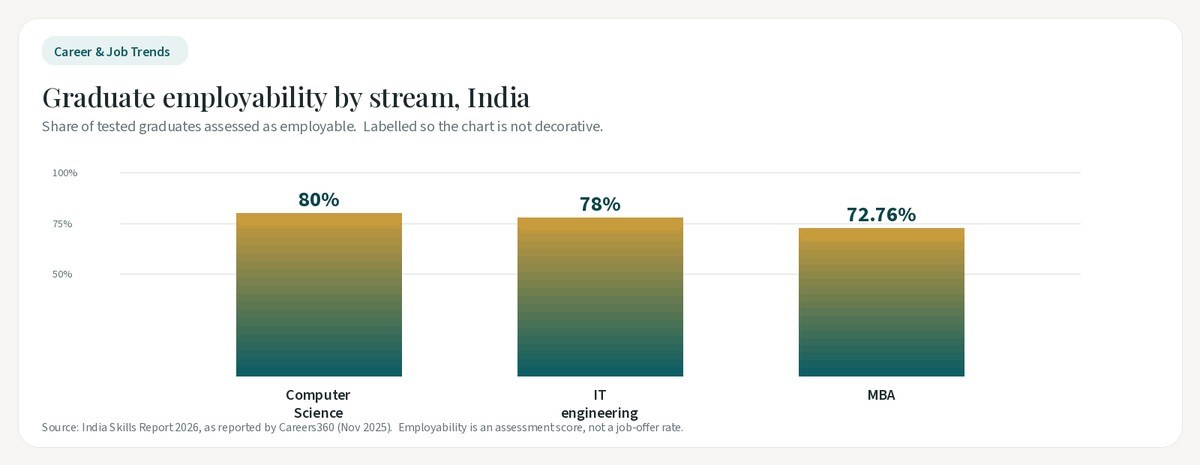
Employment information with the country and year labelled, so you know what the figure actually describes.
Charts are shown only where reliable comparable data exists. Where it does not, we say so instead of estimating.
Universities to explore, with the ranking source and year shown wherever a ranking is mentioned.
Global universities with location, subject category, and the ranking source and year.
A balanced look at availability, admission requirements, cost and planning after the degree.
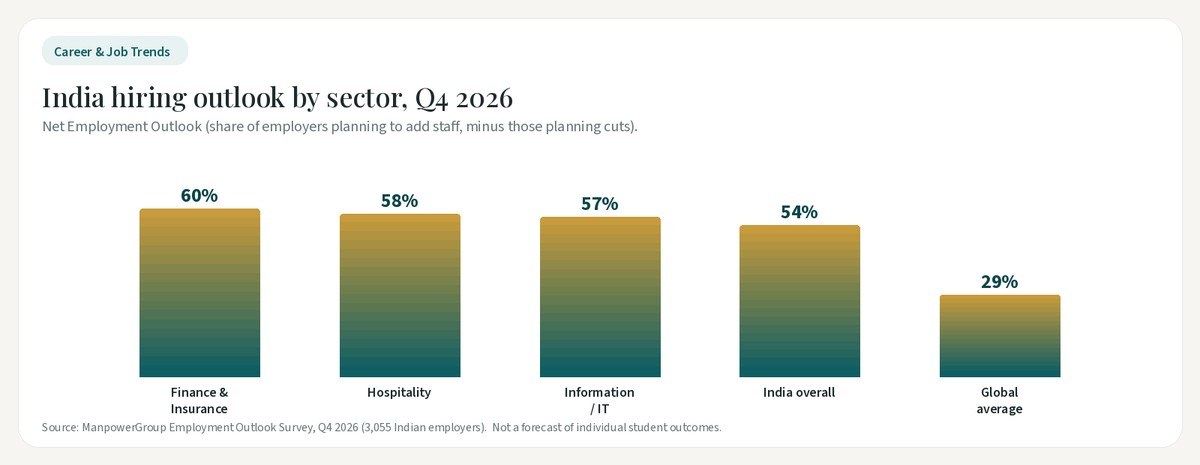
Published survey figures — not a placement promise.
Hiring in India is uneven by sector and by skill. Use trend figures to ask better questions about a programme. Do not treat them as a guarantee for one student.
Short answers to the questions families actually ask before they apply.
Working from interests and strengths to a shortlist you can defend at home.
Guides for students choosing what to study after Class 12.
Content for graduates and professionals evaluating advanced study choices.
Recognition, eligibility, flexibility and what employers and universities accept.
Cost, eligibility, destination readiness, progression and life after the degree.
Student-friendly explainers on applications, eligibility and decision factors.
Start with your interests, academic strengths, preferred subjects and long-term career direction, then compare degree options, universities and study modes.
Look at your current qualification, career goals, specialisation needs, time commitment and whether campus or online study suits your situation.
It depends on your goals, budget, preferred learning environment, destination readiness and the kind of progression you want after graduation.
It can be suitable when the programme is appropriately recognised, the format matches your schedule and the learning outcomes align with your goals.
Message the advisor on WhatsApp. Tell us the student’s current class or degree, preferred field, and India / abroad / online.